
Abstract
This paper investigates the evolution of human consciousness by synthesizing Jean Gebser’s structural history of consciousness and Sri Aurobindo’s teleological vision of post-integral evolution. Gebser posits that human awareness has progressed through a series of sudden, discontinuous mutations—Archaic, Magic, Mythic, and Mental—each arising to resolve the spatial and temporal limitations of its predecessor. The current epoch faces the crisis of thedeficient mental; phase, necessitating a mutation into the Integral, characterized by time-free diaphaneity and the harmonization of previous structures. While Gebser maps the historical and phenomenological mechanics of these transitions up to the Integral, Sri Aurobindo provides the cosmic teleology of the stage beyond the mind, termed the Supramental or post-integral consciousness. Aurobindo argues that consciousness evolution is driven by a preceding divine involution. Thus, the ultimate purpose of post- integral consciousness is not ascetic escapism, but the divinization of physical matter, the achievement of knowledge by absolute identity, and the biological emergence of Gnostic beings capable of manifesting a divine existence on Earth.
Together, these frameworks offer a comprehensive model mapping both the historical unfolding and the ultimate cosmic purpose of human awareness.

Introduction
The study of human evolution extends beyond biological morphology into the qualitative development of subjective awareness. In integral philosophy, the progression of consciousness is viewed neither as a random evolutionary byproduct nor as a static state, but as a dynamic unfolding characterized by distinct structural shifts. Two seminal figures in this domain are the Swiss phenomenologist Jean Gebser (1905–1973) and the Indian philosopher-mystic Sri Aurobindo (1872–1950). Gebser meticulously mapped the historical
and phenomenological structures of consciousness—detailing how humanity arrived at its current cognitive paradigm and why a leap to an Integral consciousness is necessary to avoid civilizational collapse. In parallel, Sri Aurobindo articulated the teleological purpose of the evolutionary arc, revealing the spiritual mechanics and ultimate destiny of the post- integral (Supramental) stage. This paper integrates ten critical points from their respective frameworks to map the trajectory of human consciousness from its primordial roots to its ultimate cosmic destiny.
2. Gebser’s Structural Mutations: How and Why Consciousness Evolves
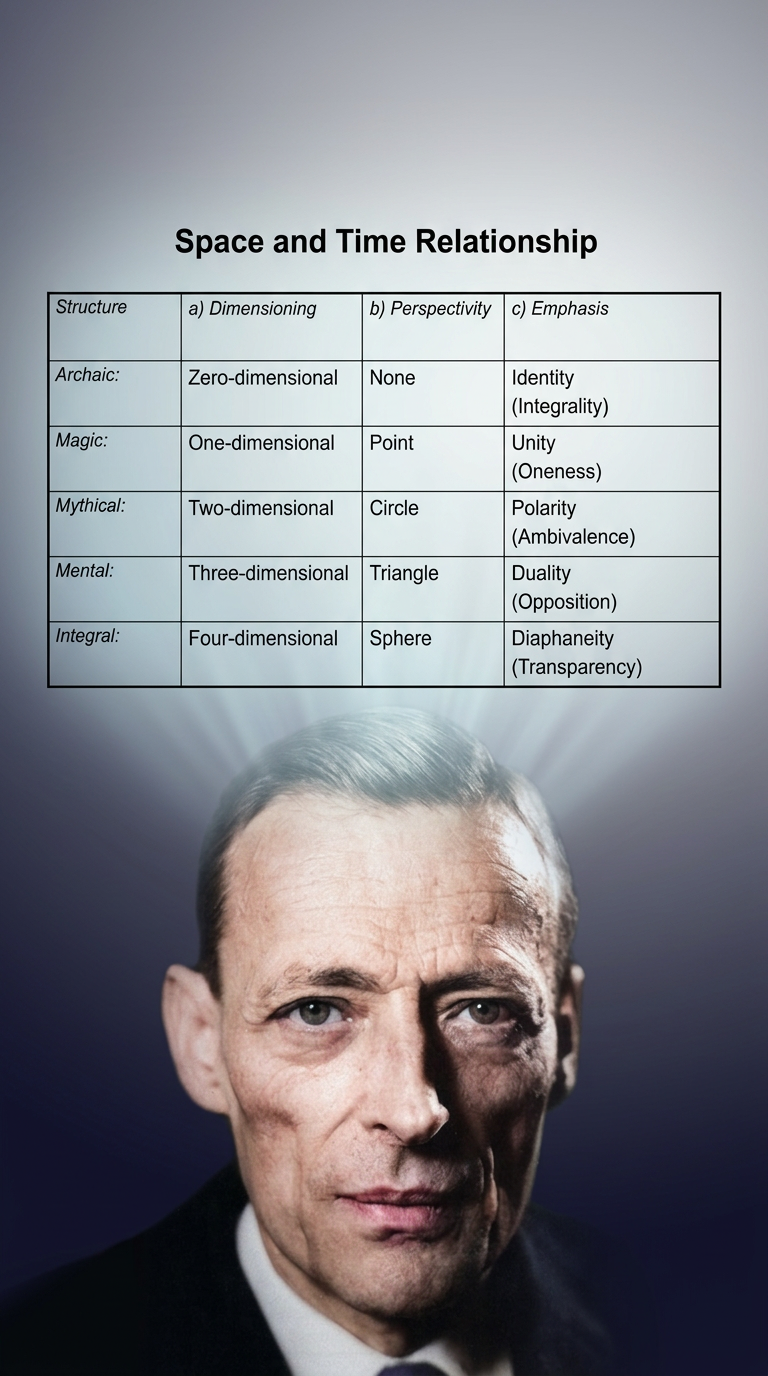
Gebser argued against a purely continuous, linear view of evolution, suggesting instead that consciousness evolves through sudden; mutations. Each mutation adds a new dimension of awareness, arising when the previous structure reaches a state of crisis or deficiency.
2.1 The Archaic Stage (Zero-Dimensional Non-Differentiation)
The dawn of human consciousness, the Archaic stage, was characterized by zero-dimensionality. Early hominids existed in a state of absolute, unmediated identity with the cosmos. Gebser likened this to a deep sleep state where no subject-object dichotomy existed. The purpose of this stage was foundational: it served as the undivided ontological seed—the primordial pleroma—out of which the potential for self-reflective awareness would eventually germinate (Gebser, 1985).
2.2 The Magic Stage (One-Dimensional Vital Intertwining)
As the need to navigate and survive in a complex physical environment arose, consciousness mutated into the Magic structure. This one-dimensional, point-like awareness was characterized by vital, instinctual, and telepathic interconnection. Early humans formed tribal egos, interacting with the world through ritual, spell, and totemism. The evolutionary necessity of this stage was to establish a preliminary exertion of will over nature, transforming absolute passivity into active, albeit pre-rational, agency (Feuerstein, 1987).
2.3 The Mythic Stage (Two-Dimensional Polarity and the Soul)
The increasing complexity of human societies and internal emotional landscapes triggered the mutation to the Mythic structure. Operating in a two-dimensional paradigm of cyclical time and polarity (e.g., light vs. dark, good vs. evil), this stage saw the birth of the imaginative psyche. The evolutionary purpose of the Mythic stage was the generation of vast social cohesion through shared cosmic narratives, allowing for the inner birth of the soul; distinct from the immediate natural environment (Thompson, 1981).
2.4 The Mental Stage (Three-Dimensional Egoic Rationality)
To master the material world with precision, the Mythic structure yielded to the Mental mutation. This introduced three-dimensional spatial awareness, linear time, and the highly individualized ego. The mental structure gave rise to science, philosophy, and abstract reasoning. However, its evolutionary trajectory culminated in the deficient mental state—a hyper-rational, fragmented paradigm where humanity experiences extreme alienation from nature and Spirit (Combs, 2002; Wilber, 1995).
2.5 The Integral Stage (Four-Dimensional Diaphaneity)
To resolve the existential and ecological crises generated by the deficient mental ego, a leap into the Integral structure becomes a survival imperative. Gebser characterized this not as an expansion of intellect, but as diaphaneity—a transparent rendering of reality. The Integral mutation integrates all previous structures (archaic, magic, mythic, mental) without being exclusively bound by any of them. It operates in ;time-freedom, perceiving the origin of consciousness as ever-present, thereby healing the subject-object divide and rescuing humanity from self-destruction (Gebser, 1985; Mahood, 2018).
3. Aurobindo’s Supramental Vision: The Purpose of the Post-Integral Stage
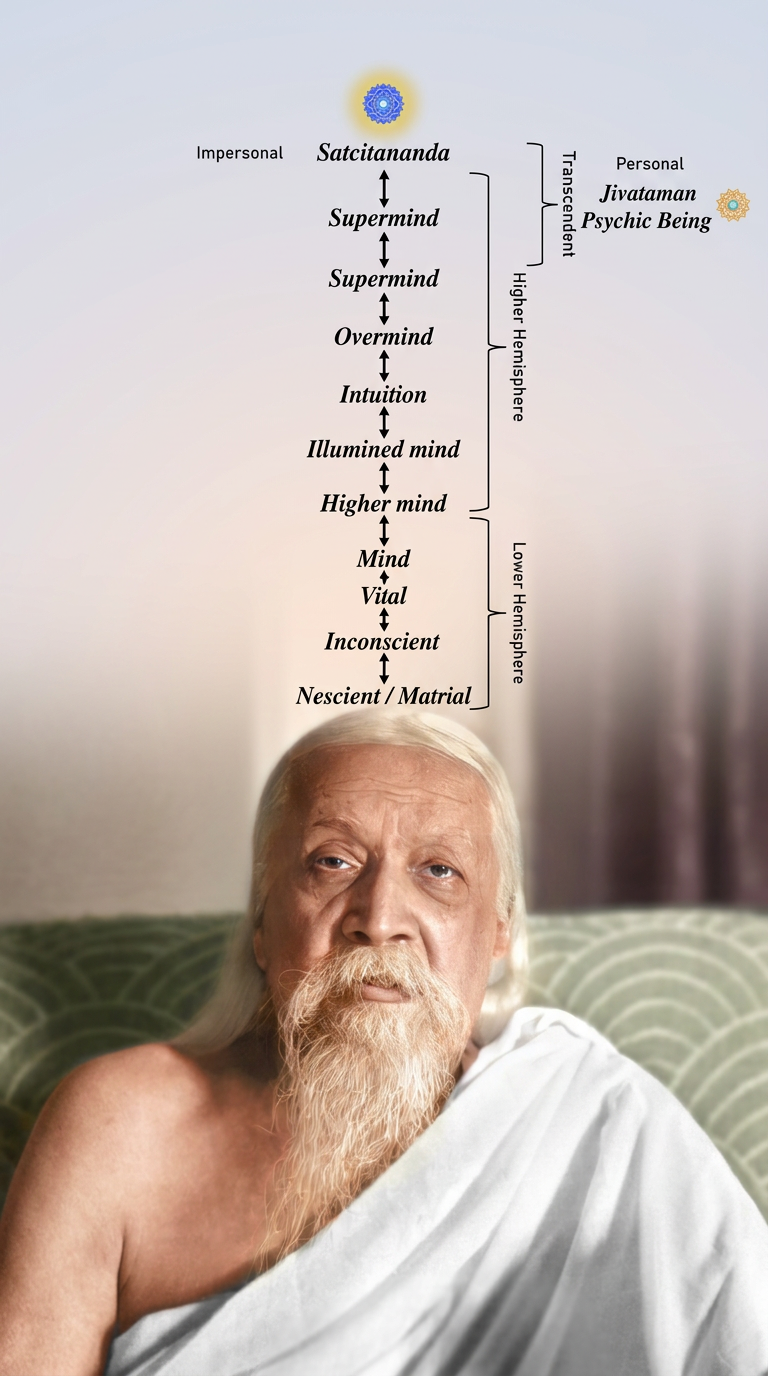
While Gebser outlines the structural necessity of the Integral leap, Sri Aurobindo provides the metaphysical teleology of what lies beyond the mind. The transition from the Mental to the Integral is only a threshold to the Supramental phase, which Aurobindo views as the true purpose of cosmic evolution.
3.1 Involution as the Precursor to Evolution
For Aurobindo, the evolution of consciousness is not an accidental emergence from inert matter. It is propelled by a preceding process called involution. The Divine previously concealed itself, descending through gradations of consciousness down into dense, seemingly unconscious matter. The purpose of the post-integral evolution is the systematic unfolding and self-recollection of this involved Divinity. The mind is thus categorized as a transitional instrument, not the pinnacle of conscious potential (Aurobindo, 2005; McDermott, 2001).
3.2 The Divinization of Matter
Historically, profound spiritual awakening has often been synonymous with asceticism—an escape from the physical plane (Samsara) into an unmanifest reality (Nirvana or Moksha). Aurobindo radically redefines the purpose of spiritual evolution. The Supramental consciousness does not seek to abandon the Earth; rather, it aims to draw spiritual light down to transform the physical plane. The ultimate goal is the spiritualization of the physical body and the Earth itself, turning matter into a perfect, transparent vessel for the Spirit (Chaudhuri, 1977; Hatcher, 1999).
3.3 Achieving Knowledge by Identity
The mental consciousness operates inherently through division, attempting to acquire knowledge by analysing an object from the outside. In stark contrast, the purpose of the Supramental stage is to establish ;Knowledge by Identity. ; In this state, epistemic distance dissolves. An individual knows a truth, an object, or another being not through deductive logic, but because they experience a living, ontological oneness with it. Ignorance (Avidya) is thus fundamentally eradicated (Aurobindo, 2005).
3.4 Harmonizing the One and the Many
A perennial struggle of the mental stage is reconciling the paradox of the One (unity) and the Many (multiplicity). The Supramental consciousness is inherently capable of holding; Unity in Diversity. ; Its evolutionary purpose is to allow individuals to express their unique, differentiated nature perfectly without ever losing the continuous, lived realization that they are inseparable extensions of the single Divine fabric (Wilber, 1995; Chaudhuri, 1977).
3.5 The Emergence of Gnostic Beings and The Life Divine
The culmination of post-integral evolution is ontological and biological speciation. Aurobindo posits that just as the animal kingdom gave rise to mentally self-aware humans, the current human species is destined to birth – Gnostic Beings. These beings will operate entirely from Truth-Consciousness, devoid of the separative ego, suffering, and falsehood. Their collective existence will establish what Aurobindo termed the Life Divine on Earth—a perfectly harmonious, creative expression of the cosmos fully awake to itself (Aurobindo, 2005; McDermott, 2001).
Conclusion
The frameworks of Jean Gebser and Sri Aurobindo offer profoundly complementary insights into the trajectory of human consciousness. Gebser’s phenomenology demonstrates that our evolutionary journey has been a stepwise mastery of time and space, moving from archaic slumber to the threshold of integral transparency. Aurobindo’s teleology picks up at this threshold, revealing that the ultimate purpose of this journey is not merely cognitive mastery or psychological peace, but a radical cosmic transformation. The post-integral evolution aims at reversing the primordial involution, transmuting physical matter, and birthing a Supramental humanity capable of manifesting a divine existence upon the Earth.
References
- Aurobindo, S. (2005). The Life Divine. Pondicherry: Sri Aurobindo Ashram Trust.
- Chaudhuri, H. (1977). The Evolution of Integral Consciousness. Wheaton, IL: Quest Books.
- Combs, A. (2002). The Radiance of Being: Understanding the Grand Integral Vision;
- Living the Healthy Life (2nd ed.). St. Paul, MN: Paragon House.
- Feuerstein, G. (1987). Structures of Consciousness: The Genius of Jean Gebser. Lower
- Lake, CA: Integral Publishing.
- Gebser, J. (1985). The Ever-Present Origin (N. Barstad & A. Mickunas, Trans.). Athens, Ohio University Press.
- Hatcher, B. A. (1999). Eclecticism and Modern Hindu Discourse. New York: Oxford University Press.
- Mahood, E. (2018). The Evolution of Consciousness: An Introduction to Jean Gebser. London: Integral Imprint.
- McDermott, R. A. (2001). The Essential Aurobindo: Writings of Sri Aurobindo. Great
- Barrington, MA: Lindisfarne Books.
- Thompson, W. I. (1981). The Time Falling Bodies Take to Light: Mythology, Sexuality and the Origins of Culture. New York: St. Martin s Press.
- Wilber, K. (1995). Sex, Ecology, Spirituality: The Spirit of Evolution. Boston, MA: Shambhala Publications.
Know more about science and spirituality in our YouTube channel – Decode
TARGET AUDIENCE FOR BLOG
- Scholars and Researchers in Integral Philosophy: Academics studying the frameworks of thinkers like Gebser, Aurobindo, and Ken Wilber who need comparative analyses of consciousness models.
- Students of Transpersonal Psychology: Individuals interested in the intersection of psychological development and spiritual awakening beyond the standard egoic/mental stages.
- Practitioners of Evolutionary Spirituality: Spiritual seekers and readers of Eastern mysticism (specifically Integral Yoga) looking for a grounded, structural understanding of human destiny and the divinization of life.
- Sociologists and Historians of Consciousness: Professionals seeking to understand how civilizational shifts (from archaic to mental to integral) map onto human cognitive evolution and social structures.

0 Comments