

Abstract
From the avenues of Paris to the streets of New Delhi and Kathmandu, a tidal wave of youth unrest is sweeping the globe. This alienation is not merely youthful rebellion; it is a profound, organized rejection of a fractured status quo. Driven by a volatile mix of economic despair, political alienation, and digital amplification, youth unrest is taking to the streets to demand a structural overhaul.
- See the Appendix Below for Hotspots of Youth unrest in the 21st century
Fundamental Causes of the Frustration
- Economic Exclusion and Inequality: At the heart of this unrest lies deep-seated economic anxiety. Young people today are arguably the most educated generation in history, yet they face precarious job markets and crippling unemployment. The relentless cost-of-living crisis, paired with spiralling wealth inequality, has severely eroded the promise of upward social mobility. In many nations, the decay of welfare systems and the sheer unaffordability of basic needs—from housing to healthcare—leave the youth feeling systematically locked out of the prosperity enjoyed by older demographics resulting in youth unrest and alienation.
- Political Disconnect and Governance Failures: There is a yawning generational gulf between the governed and the governing. Political elites are frequently perceived as out-of-touch and self-serving, often flaunting wealth while imposing austerity. Protests are frequently triggered by blatant governance failures—such as the botched national medical exams in India, undemocratic budget policies in Europe, or the opulent lifestyles of political elites that triggered social media bans in Nepal. Furthermore, when governments respond to these grievances with heavy-handed repression, internet blackouts, or surveillance rather than dialogue, it only inflames the outrage resulting in alienation and youth unrest.
- The Digital Accelerant and Mental Health: The digital landscape acts as both a mirror and an engine. Constant exposure to global disparities, economic alienation and catastrophic news via social media has fuelled an epidemic of anxiety, depression, and ecological dread among the youth. Yet, this same technology equips them with formidable tools for “digital activism.” Agile, leaderless movements can now mobilize youth unrest overnight via encrypted apps, rapidly turning localized anger into transnational demands for justice.

Actionable Pathways for Reform
Quelling this global frustration requires moving beyond tear gas fueling youth unrest and temporary concessions. Institutional systems must undergo foundational reform across two major sectors:
- Socio-Economic Actions:
- Overhaul the Social Contract: Governments must prioritize progressive taxation and robust social safety nets to curb runaway wealth concentration and alleviate the immediate cost-of-living burdens avoiding youth unrest and alienation.
- Targeted Job Creation: The private and public sectors must collaborate on structural economic reforms that generate secure, sustainable employment. This includes investing heavily in the green energy transition and digital innovation hubs.
- Invest in Public Wellbeing: Reversing the erosion of public services is vital. This requires making higher education affordable and vastly expanding accessible mental health infrastructure to address the psychological toll of modern digital and economic pressures thereby quelling youth unrest.
- Political Actions:
- Institutionalize Youth Participation: The political establishment must actively integrate the youth demographic. Establishing binding youth advisory councils and lowering the age limits for political office can bring these marginalized voices directly to the policy-making table.
- Enforce Democratic Accountability: Governments must implement strict anti-corruption measures, mandate transparent citizen-led audits of public spending, and dismantle policies that shield politicians from accountability.
- Shift from Repression to Dialogue: State apparatuses must decriminalize peaceful protests and establish open channels for civic dialogue, recognizing that systemic dissent is a symptom of governance failure rather than a pure security threat.
The mushrooming global youth unrest is a clarion call. The younger generation is refusing to quietly inherit an exclusionary system. Only by genuinely integrating their voices into the halls of power and rewriting the socio-economic contract can we transform this explosive frustration into constructive societal progress.
Appendix – Hotspots of Youth unrest in the 21st century
Asia
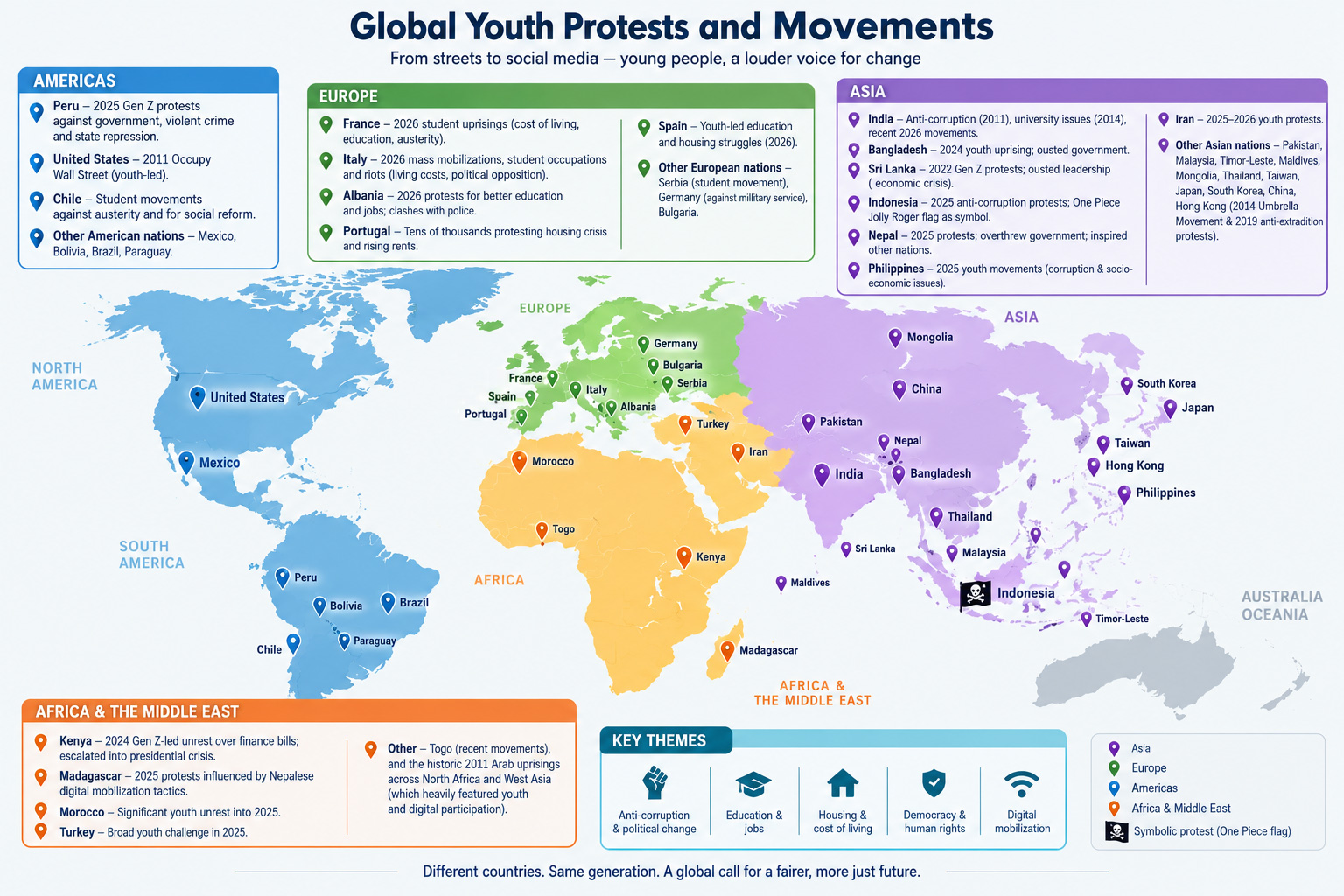
- India: Widespread youth unrest in 21st-century protests spanning anti-corruption (2011), university issues (2014), and recent 2026 movements.
- Bangladesh: A successful 2024 youth unrest and uprising that resulted in the overthrow of the national government.
- Sri Lanka: Gen Z protests in 2022 that successfully ousted the national leadership during a severe economic crisis.
- Indonesia: Multiple waves of youth unrest, including 2025 anti-corruption protests where demonstrators adopted the One Piece Jolly Roger flag as a symbol of rebellion.
- Nepal: Extensive Gen Z protests in 2025 that overthrew the government and actively inspired youth organizers in other nations.
- Philippines: Recent youth-led movements in 2025 addressing corruption and socioeconomic issues.
- Iran: Significant 2025–2026 youth protests.
- Other Asian Nations: Pakistan, Malaysia, Timor-Leste, Maldives, Mongolia, Thailand, Taiwan, Japan, South Korea, China, and Hong Kong (including the 2014 Umbrella Movement and 2019 anti-extradition protests).
Europe
- France: Major 2026 student uprisings targeting the cost of living, educational conditions, and austerity measures.
- Italy: Mass youth mobilizations, student occupations, and riots in 2026 over living costs and political opposition.
- Albania: Protests demanding improved education and job opportunities in 2026, leading to clashes with police.
- Portugal: Tens of thousands of young demonstrators protesting the housing crisis and rising rents.
- Spain: Youth-led education and housing struggles in 2026.
- Other European Nations: Serbia (student protest movement), Germany (mobilizations against military service), and Bulgaria.
Americas
- Peru: Significant Gen Z protests in 2025 against the government, exacerbated by violent crime and state repression.
- United States: The 2011 Occupy Wall Street movement, which was heavily propelled by youth participation.
- Chile: Student movements protesting austerity measures and demanding social reform.
- Other American Nations: Mexico, Bolivia, Brazil, and Paraguay.
Africa & The Middle East
- Kenya: Gen Z-led unrest starting in 2024 over controversial finance bills, escalating into a massive presidential crisis.
- Madagascar: Youth protests in 2025 influenced by the digital mobilization tactics of the Nepalese uprisings.
- Morocco: Significant youth unrest continuing into 2025.
- Turkey: A broad youth challenge against the political establishment in 2025.
- Broader Regions: Specific recent movements in Togo, alongside the historic 2011 Arab uprisings across North Africa and West Asia, which heavily featured youth and digital participation.
Know more about science, spirituality and the human condition in our YouTube channel – Decode

0 Comments