
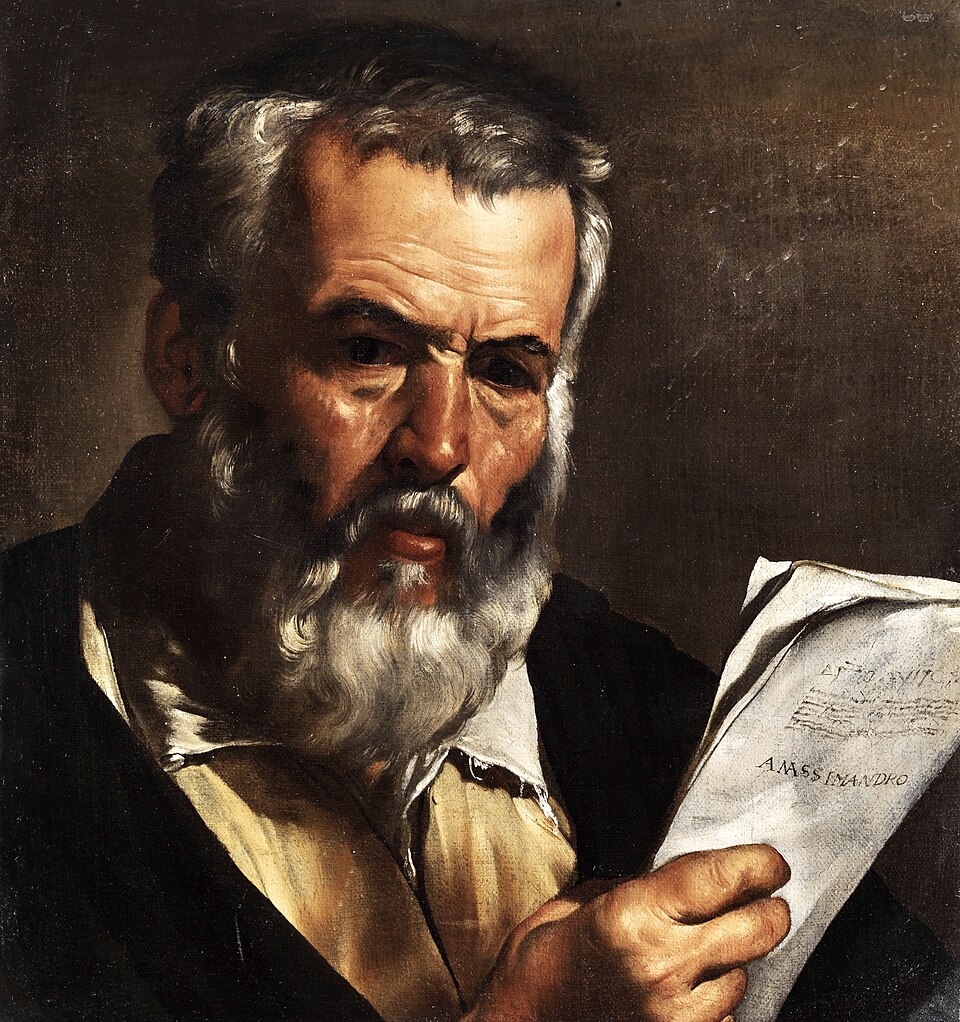
Before Einstein or Newton, there was Anaximander. He dared to suggest a universe governed by natural laws rather than gods, proposing the apeiron—an eternal, boundless source similar to modern concepts of the cosmos.
Dive into my latest blog post to see how the early Greek philosophers laid the blueprint for modern cosmology
Anaximander and the Apeiron
The cosmology of Anaximander of Miletus (c. 610–546 BCE) and his contemporaries marked a pivotal departure from mythological narratives toward rational, naturalistic explanations of the cosmos. This article examines how Anaximander’s concept of the apeiron—an eternal, boundless source—and his vision of an open, unsupported universe laid foundational principles for scientific inquiry.
Extending to other early Greek philosophers like Thales and Anaximenes, these ideas fostered a tradition of observation, logic, and mathematical modelling that influenced subsequent developments, from Aristotelian geocentricism to the heliocentric revolution and, ultimately, contemporary Big Bang cosmology.
By prioritizing empirical reasoning over divine intervention, these thinkers initiated the intellectual trajectory that defines modern cosmology. Drawing on primary fragments and secondary scholarship, this analysis underscores their enduring legacy.
Introduction to Anaximander
In the sixth century BCE, the Ionian city of Miletus emerged as a cradle of intellectual innovation, challenging the anthropomorphic cosmogonies of Near Eastern mythologies. Anaximander, a disciple of Thales, stands as a seminal figure in this transition, proposing a universe governed by impersonal principles rather than capricious gods.
His bold speculations, preserved in fragmentary accounts by later authors like Aristotle and Theophrastus, introduced concepts of infinity, separation of opposites, and cosmic equilibrium that resonate with modern notions of symmetry and entropy.
This article explores how Anaximander’s cosmology, alongside contributions from early Greek philosophers, established core tenets—rational explanation, spatial abstraction, and evolutionary processes—that propelled the evolution of cosmological thought through antiquity, the Renaissance, and into the era of general relativity and cosmic microwave background radiation.
Anaximander’s Cosmology: The Unbounded and the Open Universe
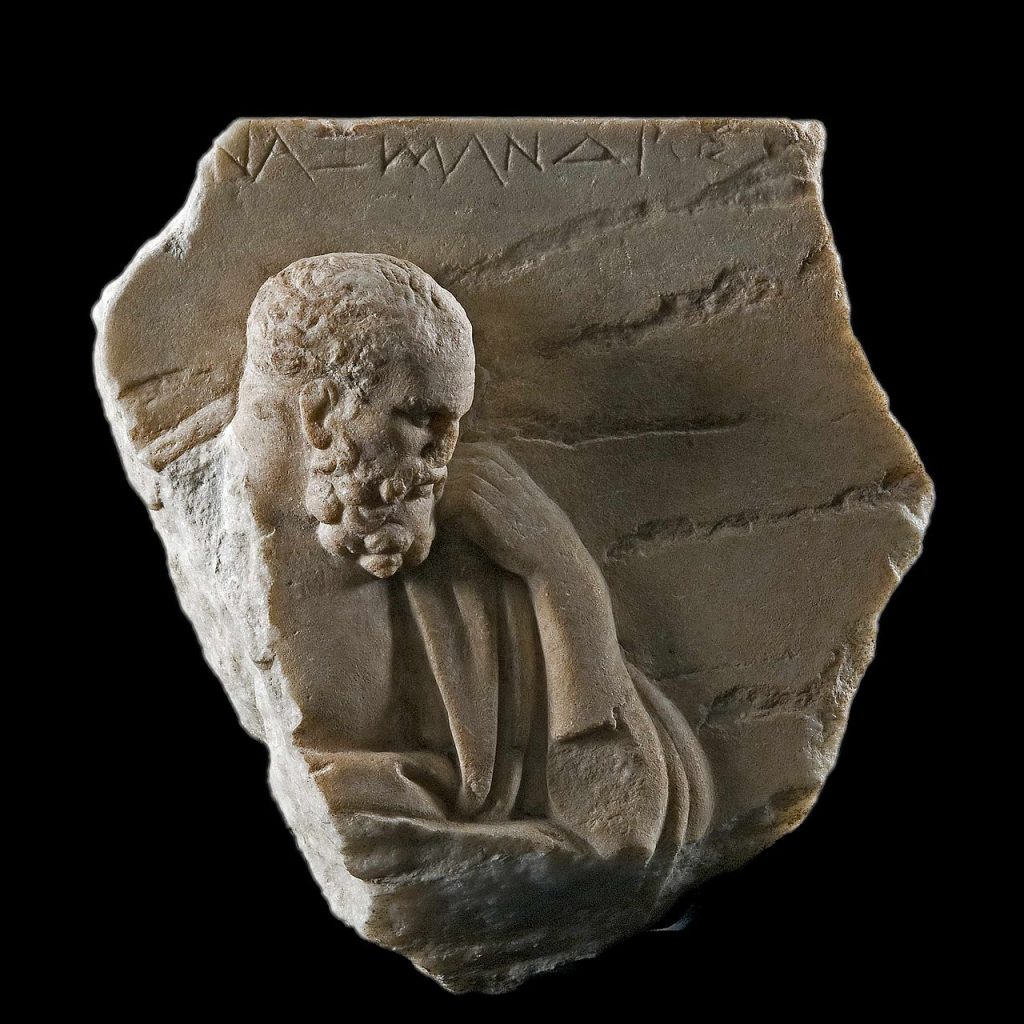
Anaximander’s most revolutionary contribution was the apeiron, an unbounded, eternal, and indeterminate substance from which the cosmos emerges through processes of differentiation and opposition.
Unlike Thales’ water or Anaximenes’ air as primary substances, the apeiron transcends specific qualities, embodying infinite potentiality and serving as both origin (archē) and reservoir for all phenomena.
As preserved in a key fragment (DK 12B1), “Whence things have their origin, thence also their destruction happens, as is the order of things; for they execute the sentence upon one another—the condemnation for the crime—in conformity with the ordinance of Time,” this principle invokes a cosmic justice, where elemental opposites (hot/cold, wet/dry) arise, conflict, and resolve in eternal cycles.
Structurally, Anaximander envisioned an open universe, discarding the mythical vault of heaven for a spatially infinite expanse. The Earth, cylindrical and flat-topped, floats unsupported at the centre, stabilized by symmetry—equidistant from cosmic poles, it neither rises nor falls, prefiguring inertial principles in Newtonian mechanics.
Celestial bodies orbit in fiery rings shrouded by mist, with the sun, moon, and stars at proportional distances (27–28, 18–19, and 9–10 Earth diameters, respectively), allowing geometric predictions of eclipses and phases. This model, while empirically flawed, introduced abstraction: the universe as a mathematical construct, not a divine artifact.
Anaximander extended rationalism to terrestrial phenomena, attributing winds to rarefied air, rain to solar evaporation, and life’s origins to moist genesis followed by adaptation—hints of evolutionary theory millennia before Darwin. His methodology—observation wedded to logic—rejected teleology, insisting on immanent causes, a cornerstone of scientific naturalism.
Early Greek Philosophers: Expanding the Milesian Framework
Anaximander’s ideas did not emerge in isolation but built upon and inspired the Milesian school and beyond. Thales (c. 624–546 BCE), often hailed as the first philosopher, posited water as the primordial element, with Earth as a disc afloat upon it, and predicted eclipses via cycle arithmetic. This demythologization—explaining earthquakes as oceanic sway rather than Poseidon’s wrath—set the rational tone.
Anaximenes (c. 585–528 BCE) refined the archē to air, an infinite medium undergoing condensation and rarefaction to yield all matter, introducing quantitative change over qualitative leaps.
Pythagoras (c. 570–495 BCE) infused mathematics into cosmology, viewing the cosmos as a harmonious sphere governed by numerical ratios, with celestial music inaudible to mortals. Heraclitus emphasized flux (“Everything flows”), positing fire as the dynamic principle, while Parmenides’ monism challenged multiplicity, demanding logical rigor in ontological claims.
The Atomists, Leucippus and Democritus (fifth century BCE), synthesized these threads into a pluralistic void-filled universe of indivisible atoms in eternal motion, anticipating mechanistic materialism. Collectively, these thinkers shifted cosmology from genealogy to geometry, fostering pluralism (multiple worlds) and infinity, ideas dormant yet seminal for later revivals.
Greek Cosmology’s Trajectory: From Geocentrism to Heliocentrism
Aristotle (384–322 BCE) systematized these insights into a finite, geocentric cosmos: sublunary sphere of mutable elements contrasted with supralunary quintessence in perfect spheres. Though critiquing Anaximander’s apeiron as illogical, Aristotle adopted his emphasis on natural causation. Ptolemy’s Almagest (c. 150 CE) refined this with epicycles, enabling precise predictions and dominating for 1,400 years via Islamic preservation.
Aristarchus of Samos (c. 310–230 BCE) proposed heliocentrism, with Earth orbiting the Sun, grounded in observational geometry—echoing Anaximander’s proportional distances. Though marginalized, this model resurfaced in Copernicus’ De Revolutionibus (1543), who cited Greek precedents to dismantle Ptolemaic complexity.
Galileo’s telescopic validations and Kepler’s elliptical orbits built on this rational lineage, culminating in Newton’s gravitational synthesis (1687), where universal laws supplanted ad hoc spheres.

Bridges to Contemporary Cosmology
The Greek insistence on empirical verification and mathematical elegance persists in modern cosmology.
Einstein’s general relativity (1915) recasts gravity as spacetime curvature, echoing Anaximander’s equilibrium in an infinite manifold.
The Big Bang theory (1927 onward), positing an initial singularity expanding into differentiated structures, mirrors the apeiron‘s generative separation, with cosmic microwave background uniformity evoking early Greek symmetry. Evolutionary cosmology, from nucleosynthesis to galaxy formation, reflects Anaximander’s biological progressions, integrated via natural selection analogues in astrophysics.
Moreover, the multiverse hypothesis in quantum cosmology revives Atomist pluralism, while dark energy’s repulsive force parallels Heraclitean flux. Greek methodology—hypothesis testing via observation—underpins the scientific method, as formalized by Bacon and Descartes, ensuring cosmology’s progression from speculation to simulation.
Conclusion
Anaximander and early Greek philosophers did not merely posit models; they ignited a paradigm of inquiry that demystified the heavens, privileging reason over revelation.
From the apeiron’s boundless creativity to Democritus’ atomic voids, their cosmology seeded the intellectual soil for Ptolemy’s precision, Copernicus’ audacity, and Hubble’s expansion.
Today, as we probe cosmic inflation and black hole horizons, we inherit their audacity: a universe explicable, not enchanted. Though fragments alone survive, their legacy endures in every equation charting our cosmic odyssey.
References
- Barnes, J. (1982). Early Greek Philosophy. Penguin Classics.
- Diels, H., & Kranz, W. (1964). Die Fragmente der Vorsokratiker. Weidmann.
- Guthrie, W. K. C. (1962). A History of Greek Philosophy, Vol. I: The Earlier Presocratics and the Pythagoreans. Cambridge University Press.
- Kahn, C. H. (1994). Anaximander and the Origins of Greek Cosmology. Columbia University Press.
- Kirk, G. S., Raven, J. E., & Schofield, M. (1995). The Presocratic Philosophers (2nd ed.). Cambridge University Press.
- Laks, A. (2018). The Concept of Presocratic Philosophy: Its Origin, Development, and Significance. Princeton University Press.
- McKirahan, R. D. (2010). Philosophy Before Socrates: An Introduction with Texts and Commentary (2nd ed.). Hackett Publishing.
- Warren, J. (2007). Presocratics. Acumen Publishing.

0 Comments