
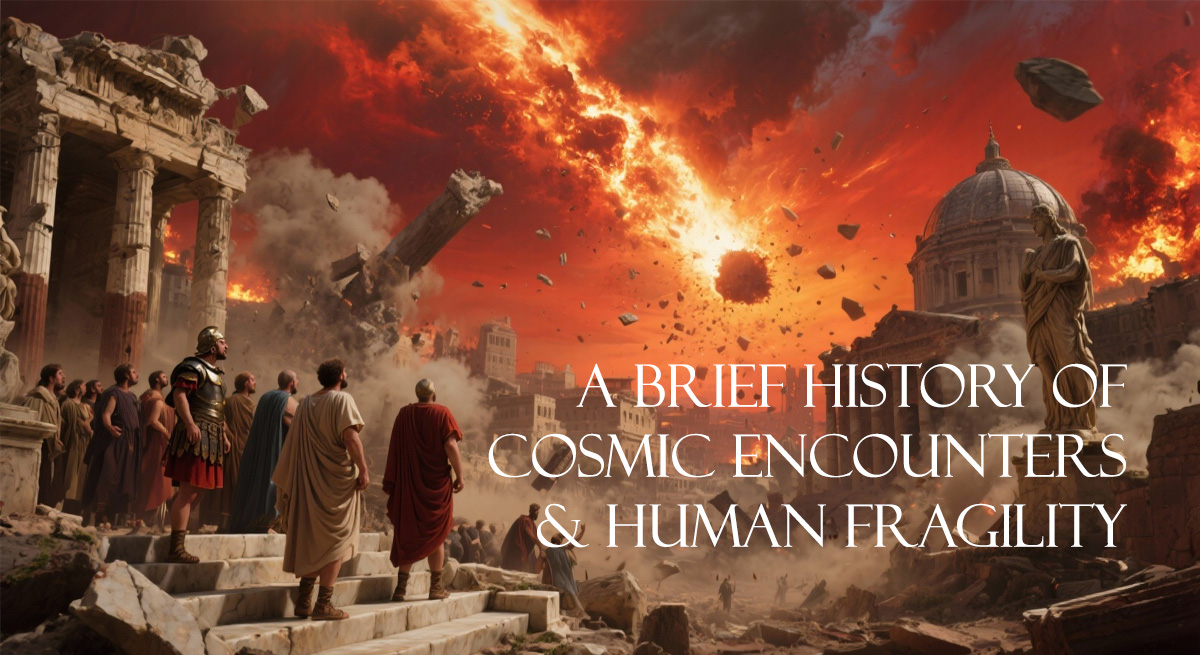
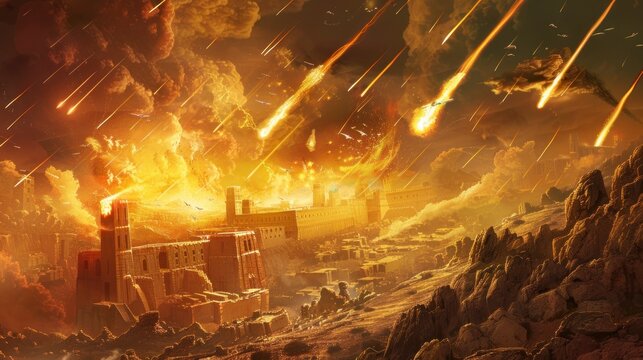
A Brief History of Cosmic Encounters and Human Fragility
Comets, Catastrophes, and Contingency
(A spiritual adaptation through the Biblical Flood, the Fall of Fortification of Jerico and the Destruction of Sodom & Gomorrah)
Introduction
From the slow ballet of planets to the feathery tails of comets, the solar system is a dynamic arena of matter in motion. Most of these objects follow predictable paths and pose no threat to life on Earth; some, however, have intersected our planet’s trajectory in ways that have mattered profoundly. Recent astronomical attention to a predicted close encounter with a comet stream in 2032 invites reflection: catastrophic impacts and atmospheric disintegrations are part of Earth’s natural history, and human societies — fragile, localized, and historically contingent — have endured and been shaped by them. This essay brings together scientific evidence, geological and historical records, and cultural memory to examine three categories of events often discussed in public and scholarly discourse: large-scale collapses of ice and climate perturbations possibly tied to cometary activity (with a focus on events ~14,000 years ago), mid-Holocene atmospheric explosions and regional devastation sometimes associated with cultural narratives (around 3,500 years ago), and more recent atmospheric disintegration events (for example, the 1908 Tunguska event and later Siberian atmospheric phenomena). We will explore what is known, what remains debated, and what these episodes collectively reveal about the precariousness of human existence on Earth.

- Cometary encounters and late Pleistocene–early Holocene changes (~14,000 years ago)
At the end of the last glacial period, Earth experienced rapid climate fluctuations and profound changes in ice sheets and sea level. Some hypotheses propose that impacts or close passages of cometary debris contributed to abrupt environmental change. The most-discussed scenario in this category is the Younger Dryas interval (~12,900–11,700 years ago), a return to near-glacial conditions during a broader warming trend. Several researchers have suggested evidence for extraterrestrial forcing — such as micro-spherules, high-temperature melt-glass, elevated levels of certain platinum-group elements, and widespread charcoal layers — that could indicate comet airbursts or impacts. The implications for large ice masses and regional climate are consequential: a major energy input into the atmosphere or surface could accelerate ice-sheet destabilization and trigger rapid meltwater pulses with knock-on effects on ocean circulation and climate.
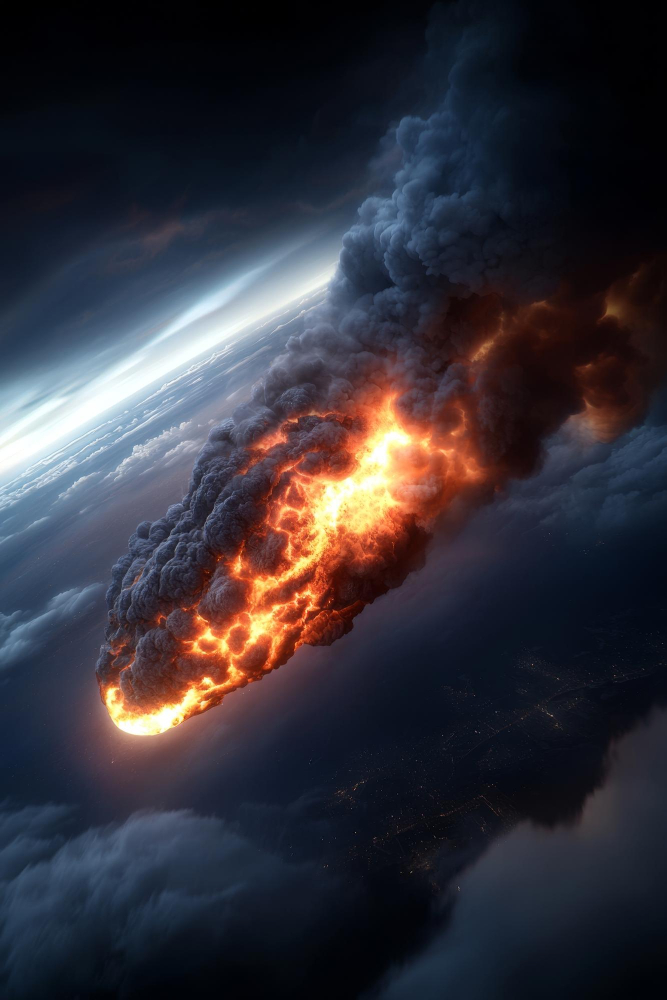
A related, broader theme involves debris streams from long-period comets that periodically intersect Earth’s orbit. When dense swarms of meteoroids enter the atmosphere, they typically burn as meteors; but under certain conditions—if a large body fragments at low altitude or multiple large fragments enter in rapid succession—the event can produce airbursts, shock waves, and surface damage. Large-scale input of particulates and smoke into the atmosphere could also alter climate over years to decades.
Geologic evidence from the terminal Pleistocene includes meltwater pulses, shifts in ocean salinity and circulation, and rapid regional warming or cooling episodes. Whether cometary activity played a decisive role in these transitions remains a subject of active research and debate. The correlation of some geochemical anomalies with the Younger Dryas onset offers a compelling narrative, but causation is not conclusively established: alternative explanations include internal Earth system feedback, solar variability, volcanic forcing, or combinations of factors. Nonetheless, the possibility that cosmic encounters contributed to abrupt climate and ice-sheet behaviour highlights one mechanism by which relatively brief astronomical events could have far-reaching terrestrial consequences.
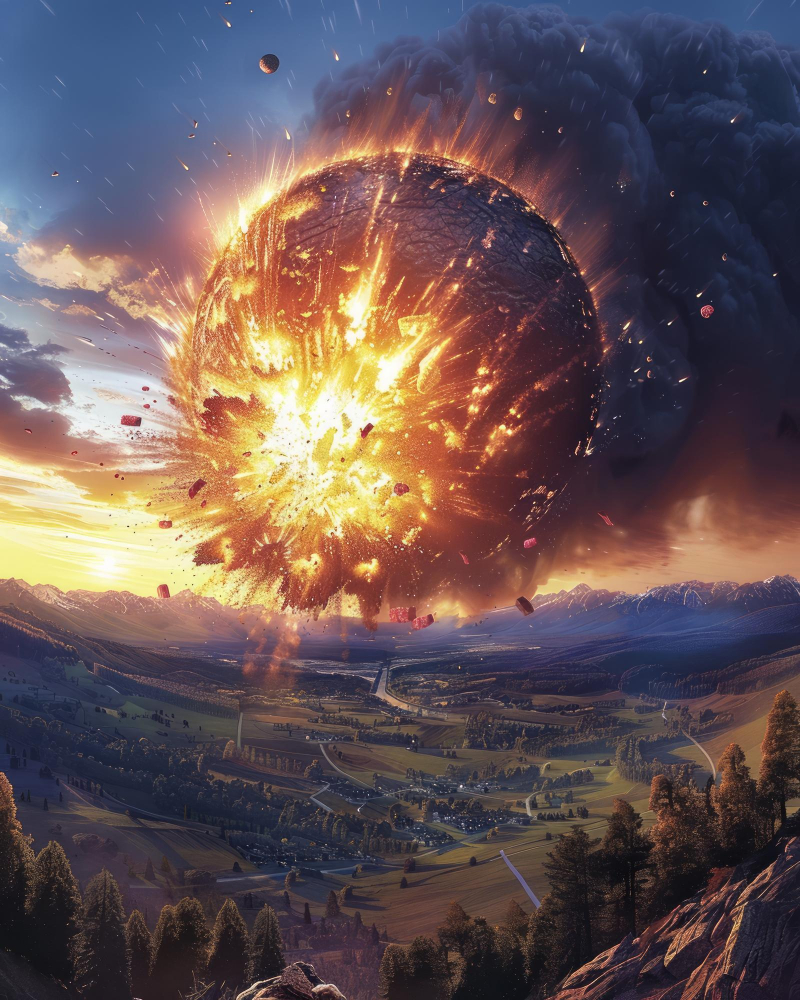
- Mid-Holocene atmospheric explosions and archaeological correlates (~3,500 years ago)
The mid to late Holocene (the last ~10,000 years) is characterized by dense human occupation across many landscapes, the rise and fall of cities, and the development of complex societies. In some regions, archaeologists and historians have long noted abrupt cultural changes, city destructions, and shifts in settlement patterns that sometimes align in time with hypothesized atmospheric explosions or meteoritic events. One widely discussed example in popular and some scholarly accounts links catastrophic fire and destruction in the Levant and surrounding regions to mid-second millennium BCE events. Traditions such as the Biblical destruction of Sodom and Gomorrah or the story of Jericho’s walls collapsing have captivated researchers because they are vivid cultural memories of sudden catastrophe; some investigators have searched for connections between these narratives and physical events such as earthquakes, warfare, or atmospheric phenomena.
Meteor disintegration in the atmosphere — an airburst — can produce intense localized devastation without leaving a classic impact crater. High-altitude fragmentation generates shock waves, thermal radiation, and wide distribution of energetic fragments and dust. Such events have been proposed as explanations for local layers of burning and destruction in archaeological contexts. Nevertheless, assigning a specific archaeological destruction to a meteoritic airburst requires careful, multidisciplinary evidence: geochemical markers, widespread high-temperature signatures, patterns of structural collapse consistent with blast mechanics (rather than prolonged burning from human conflict), and chronological precision.
The mid-Holocene timeframe includes many regionally important episodes: urban collapses, migrations, the fall of palace centres, and cultural transformations. While some of these have been robustly attributed to human conflict, drought, or economic stress, others remain ambiguous. Scientific caution is essential: the archaeological record is fragmentary and narratives are often reused and reshaped through generations. A meteor airburst is an attractive explanation for certain sudden destructions because it can produce dramatic, localized damage consistent with powerful, short-lived phenomena described in cultural memory. Yet in most cases, hard evidence linking particular city destructions directly to atmospheric fragmentation remains limited or contested. Interdisciplinary fieldwork — geochemistry, stratigraphic analysis, high-resolution dating, and forensic structural study of ruins — is required to move from plausible hypothesis to confident attribution.
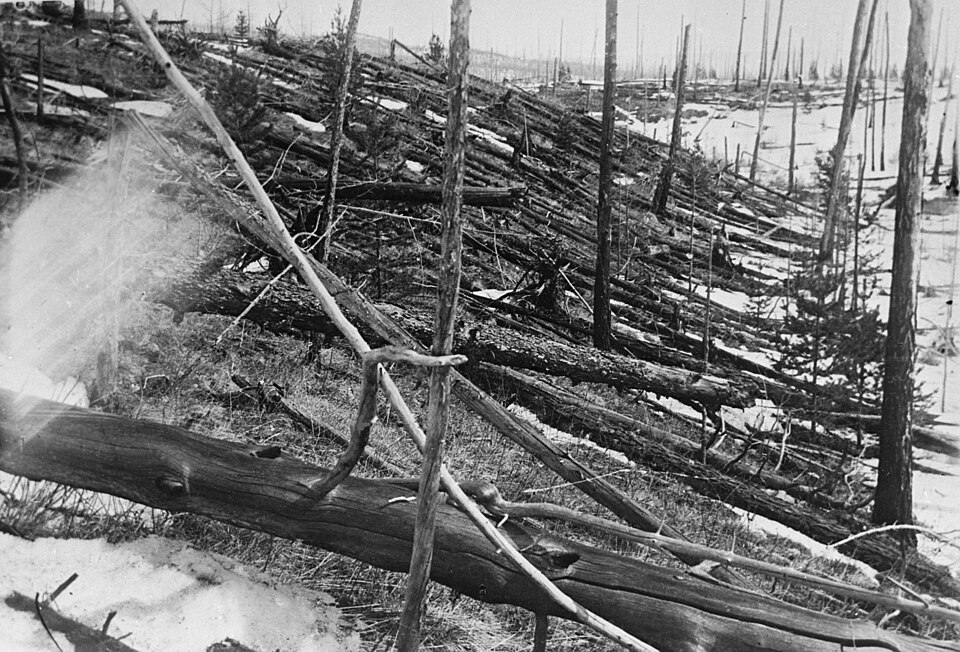
- Recent atmospheric disintegrations and the modern record (Tunguska, 1908; later Siberian events)
The modern era provides observational proof that airbursts and atmospheric disintegrations occur and can cause significant damage. The 1908 Tunguska event in Siberia is the best-known example: a large object (likely a stony meteoroid or cometary fragment tens of meters across) exploded at an altitude of several kilometres above a remote taiga, flattening some 2,000 square kilometres of forest. There was no crater; instead, the blast wave toppled trees radially and singed them, consistent with an intense atmospheric explosion. Tunguska is instructive because it demonstrates how a relatively small body, far smaller than the asteroids responsible for mass extinctions, can produce devastating regional impacts purely through airburst mechanics.
- Mechanisms of damage and the chain of consequences
Cosmic encounters affect Earth and human societies through multiple physical mechanisms:
- Direct kinetic energy: Large objects colliding with the surface convert kinetic energy into shock, heat, and excavation, producing craters and ejecta. Even without surface impact, high-velocity fragments can cause localized devastation.
- Airbursts: Fragmentation at altitude creates shock waves and thermal radiation that can topple structures, ignite fires, and cause human casualties without a crater.
- Atmospheric loading and aerosols: Widespread injection of dust, soot, and aerosols can alter climate by reducing insolation, shifting temperature and precipitation patterns, and disrupting ecosystems and agriculture.
- Tsunami generation: Ocean impacts and plate tectonics can produce tsunamis, inundate coastlines and reshape human settlement patterns.
- Secondary effects: Fires, crop failures, social dislocation, disease spread, and conflict can follow an initial physical event, amplifying human suffering.
The scale of consequences depends on object size, entry angle, fragmentation behaviour, and the geographic and socio-economic context of impact or airburst. For instance, a ground-level event in a densely populated urban area will produce far greater human tolls than a larger event in an uninhabited region.
- Archaeology, myth, and cultural memory
Human cultures preserve memories of extraordinary events in myths, religious texts, and oral traditions. The dramatic imagery of cities consumed by fire or walls falling can encode memories of real catastrophes, adapted to cultural frameworks of divine judgment, war, or moral lessons. Interpreting these narratives as literal records of cosmic events is tempting but fraught: myths condense, dramatize, and moralize; they also may integrate multiple events across centuries into single legends. Archaeology offers an empirical counterbalance, but archaeological interpretation also requires caution — aligning stratigraphy, radiocarbon dates, and geomorphic evidence with story traditions is complex.
When narratives about sudden destruction coincide with geological hints of unusual physical events, scientists can pursue convergence: correlating deposit layers with high-temperature markers, chronological concordance with cultural layers of destruction, and mechanical patterns of demolition consistent with blast effects. Even then, multiple plausible causes (earthquake, warfare, localized fire, deliberate destruction) must be ruled out before assigning an extraterrestrial origin. In the absence of such multi-proxy confirmation, hypotheses remain intriguing but provisional.
- Contemporary preparedness and the moral of contingency
Modern science gives humanity tools the ancestors lacked: systematic sky surveys cataloguing NEOs, space-based infrared observation capable of detecting faint objects, and computational models that can evaluate impact outcomes and mitigation strategies. Programs like NASA’s Planetary Défense Coordination Office, ESA’s NEO initiatives, and international scientific collaborations aim to identify hazardous objects well before they threaten Earth and to plan potential deflection or civil-protection responses.
Yet detection is incomplete. Objects arriving from the sunward direction are difficult to see from Earth until they are very close, and small but dangerous bodies like those that exploded over Tunguska or Chelyabinsk can slip past detection systems. Moreover, the human and infrastructural vulnerabilities to sudden events (cosmic encounters) remain significant: dense urban populations, fragile supply chains and climate stress can magnify the consequences of even modest cosmic perturbations significantly exposing human fragility.
The broader lesson is existential humility. Human societies have flourished in a narrow band of planetary conditions; the geological record reveals that rapid environmental shifts, whether driven internally by Earth systems or externally by cosmic forces, can disrupt and transform ecosystems and civilizations. Recognizing this contingency encourages several practical and ethical responses:
- Invest in early detection, monitoring, and international cooperation for planetary defense.
- Strengthen societal resilience through diversified food systems, robust infrastructure, emergency planning, and local capacity building.
- Preserve and study cultural memory and geological archives to better understand past events and their impacts.
- Promote scientific literacy so public discourse about risk is informed, balanced, and resistant to sensationalism.
Conclusion
From end-Pleistocene climate fluctuations that reshaped ice and sea to mid-Holocene episodes of abrupt destruction and modern atmospheric disintegrations, Earth’s history includes episodes that remind us of cosmic vulnerability. Scientific inquiry into the role of cometary streams, airbursts, and impact-generated perturbations is active and evolving: some hypotheses gain support from geochemical and geological evidence, while others remain contested. What is certain is that relatively small astronomical objects can cause regionally catastrophic effects, and that human societies remain vulnerable in ways both physical and social.
The predicted close approach of a comet stream in 2032 (if confirmed by astronomers) is an occasion for renewed attention to detection and preparedness, not panic. It is a reminder that human existence rests within a wider cosmic context. Our survival depends on combining scientific knowledge with cooperative governance and adaptive capacity. To face both the everyday and the rare-but-consequential threats from space, humanity must use its scientific tools, build resilient systems, and remember — as the geological and cultural records teach us — that contingency, not inevitability, characterizes our place on this planet.
References:
- Firestone, R. B., West, A., Kennett, J. P., et al. (2007). “Evidence for an extraterrestrial impact 12,900 years ago…” Proceedings of the National Academy of Sciences. Full text: https://www.pnas.org/content/104/41/16016
- Firestone, R. B., West, A., Kennett, J. P., et al. (2007). Evidence for an extraterrestrial impact 12,900 years ago that contributed to the megafaunal extinctions and the Younger Dryas cooling. Proceedings of the National Academy of Sciences, 104(41), 16016–16021. doi:10.1073/pnas.0706977104
- Boslough, M. B., & Crawford, D. A. (2008). Low-altitude airbursts and the impact threat. International Journal of Impact Engineering, 35(12), 1441–1448. doi:10.1016/j.ijimpeng.2008.03.003
- Brown, P., Spalding, R. E., ReVelle, D. O., Tagliaferri, E., & Worden, S. P. (2002). The flux of small near-Earth objects colliding with the Earth. Nature, 420(6913), 294–296. doi:10.1038/nature01238
- Bosse, M., Donnelly-Nolan, J. M., & others (2017). The Chelyabinsk airburst: Reconstruction and lessons learned. Meteoritics & Planetary Science, 52(11), 2116–2134. doi:10.1111/maps.12927 (Note: for detailed modern analyses of Chelyabinsk see Jenniskens et al., 2014 and Popova et al., 2013.)
- Collins, G. S., Melosh, H. J., & Marcus, R. A. (2005). Earth Impact Effects Program: A web-based computer program for calculating the regional environmental consequences of a meteoroid impact. Meteoritics & Planetary Science, 40(6), 817–840. doi:10.1111/j.1945-5100.2005.tb00157.x
Sodom & Gomorrah / Southern Levant archaeology
- Bryant G. Wood (1999). “The Archaeological Evidence for the Destruction of Jericho in the Late Bronze Age.” Near Eastern Archaeology. (PDF available) https://www.baslibrary.org/biblical-archaeology-review/25/6/7 — discusses debate over chronology and destruction layers relevant to biblical accounts.
- Joe Zias (1995). “Sodom and Gomorrah in Archaeology.” Biblical Archaeology Review (article). https://www.baslibrary.org/biblical-archaeology-review/21/5/6 — overview of archaeological searches and interpretations.
- Anastasia M. Killebrew & Robert R. Stieglitz (eds.) (2005). Archaeology and the Dead Sea Scrolls. Vol. 2 (includes regional settlement studies and surveys useful for understanding Iron Age–Bronze Age sites near the Dead Sea). Excerpts/chapters often available via academic repositories or Google Books: https://books.google.com/books?id= (search within Google Books)
Jericho
- Kathleen M. Kenyon (1981). Excavations at Jericho. Volume I: The Tombs and the Ceramics. (Classic excavation report; parts are out of print but many summaries and scanned excerpts are available.) Summary and discussion: https://www.britishmuseum.org/collection/term/BIB10387 and academic libraries.
- Bryant G. Wood (1990). “Jericho: The Evidence for the Biblical Account.” Biblical Archaeology Review. (PDF excerpts and summaries online) https://www.baslibrary.org/biblical-archaeology-review/16/4/2
- John Garstang (1928). The Story of Jericho: Excavations by the British School of Archaeology in Jerusalem. (Historic work; full text often available in archive collections) https://archive.org/details/storyofjerichoex00gars
Scholarly overviews and critical discussions
- Lawrence E. Stager (2003). “Archaeology and the Historical Study of Biblical Israel.” In The Oxford History of the Biblical World. (Provides critical synthesis of archaeology in the Levant.) Preview via Google Books: https://books.google.com/books?id= (search within Google Books)
- Bryant G. Wood (2009). “The Chronology of the Early Iron Age in Palestine and the Destruction of Jericho.” Journal of the Evangelical Theological Society. (Article accessible via academic databases; summaries online) https://biblicalarchaeology.org/daily/biblical-sites-places/jericho/jericho-and-the-bible/
- Israel Finkelstein & Neil Asher Silberman (2006). The Bible Unearthed: Archaeology’s New Vision of Ancient Israel and the Origin of Its Sacred Texts. (Critical perspective widely cited; available in many libraries and previews online) https://books.google.com/books?id= (search within Google Books)
On using archaeological evidence to infer catastrophic events
- H. H. Lamb & A. G. Ogilvie (eds.) (1999). “Climatic and Environmental Change in the Middle East: Catastrophes and Droughts” — chapters on environmental stress and societal collapse. Excerpts: https://www.cambridge.org/ (search title)
- Victor Clube & Bill Napier (1990). The Cosmic Serpent and The Cosmic Winter (discuss cometary encounters and cultural impacts). Previews via Google Books: https://books.google.com/
Notes and access tips
- Many classic excavation reports (Kenyon, Garstang) are in archive.org or university library collections; search by author and title at https://archive.org and https://babel.hathitrust.org/.
- Articles in Biblical Archaeology Review (www.biblicalarchaeology.org) are often available as full-text PDFs through the BAS library links above.
- For peer-reviewed archaeological journal access, use JSTOR, Project MUSE, or institutional library access. Google Scholar is useful for locating open-access copies or author preprints: https://scholar.google.com

0 Comments