

Abstract
This paper investigates the profound convergence of spiritual, philosophical, and cosmological insights found within the Book of Enoch and the Bhagavad Gita, proposing that these ancient texts articulate a sophisticated understanding of consciousness as the fundamental “software” of the universe. By conducting a comparative analysis of Enoch’s celestial ascensions and Krishna’s revelation of the Vishwarupa to Arjuna, we explore the metaphysical implications (Techno-Gnosis) of “divine sight”—a heightened perceptual state that reveals reality’s underlying informational architecture. Integrating perspectives from transpersonal psychology, process philosophy, and quantum information theory, the study argues that these narratives anticipate modern concepts such as the “observer effect” and the “participatory universe.” Both traditions shift the ontological focus from matter to awareness, presenting the physical world as a “rendered” output of a deeper, consciousness-mediated field. We examine how the “fall” described in these texts represents a psychological fragmentation, while “awakening” functions as a cognitive system upgrade. Ultimately, this synthesis suggests that consciousness is not an incidental byproduct of biological evolution but the primordial substrate from which all phenomena emerge, offering a radical bridge between ancient mysticism and contemporary digital physics – Techno-Gnosis – Decoding the Metaphysical Firmware of Reality

Introduction to Techno-Gnosis
The quest to understand the relationship between the mind and the cosmos has transitioned from the smoky halls of ancient temples to the sterile laboratories of quantum optics. Yet, the core question remains: is the universe a collection of cold, hard objects, or is it a dynamic, participatory event? Two seminal works of antiquity—the Book of Enoch, a pillar of Jewish pseudepigraphal literature, and the Bhagavad Gita, the jewel of Hindu philosophy—offer a startlingly modern answer. They suggest that reality is not “stuff” but “process,” governed by a consciousness that acts as the cosmic operating system. ¹
These texts provide a framework for what we might call Ancient Digital Physics. They describe a reality that is tiered, hierarchical, and fundamentally informational. Through their visionary protagonists, they illustrate that the “objective” world is a localized rendering, appearing solid only because our biological and psychological “hardware” is tuned to a specific frequency of perception (Techno-Gnosis). This paper explores this “Observer’s Awakening” across four dimensions, demonstrating how Enoch and Arjuna’s experiences serve as a blueprint for understanding the consciousness-first cosmology of the 21st century.

The Spiritual Dimension: Asceticism as System Debugging
In both the Enochian and Vedic traditions, the primary obstacle to truth is not a lack of information, but the “noise” of a corrupted interface. In the Book of Enoch, the descent of the Watchers represents a catastrophic system error—a “glitch” where celestial intelligence becomes entangled with lower-order material desires, leading to the creation of “Nephilim” or giants of disharmony. ² From a spiritual perspective, this entanglement is a form of ontological malware that obscures the source code of the divine.
Enoch’s ascension is, therefore, a process of “debugging” the self. As he moves through the heavens, he is progressively stripped of his human limitations and “clothed in the glory of the Lord.” This is not merely a change of clothes but a fundamental transformation of his being (Techno-Gnosis). Similarly, in the Bhagavad Gita, Arjuna’s initial collapse on the battlefield of Kurukshetra is described as karpanya-dosa—the flaw of pity or a systemic failure of the ego-construct. ³ Krishna’s initial response is not to provide comfort, but to challenge Arjuna’s “firmware” by asserting that the soul (Atman) is the only persistent variable in a world of transient data (Techno-Gnosis).
Spiritual practice in these contexts acts as an optimization protocol. By detaching from the “rendered” results of action (the fruit of work), the observer begins to align with the underlying logic of the system (Dharma). The “divine sight” granted to Enoch and Arjuna represents the ultimate administrative privilege: the ability to see the world not as a user, but as a developer.
The Philosophical Dimension: Idealism vs. Digital Physics
Philosophically, these texts align with Objective Idealism, the view that mind is the primary reality. However, the metaphors they use are strikingly reminiscent of modern Simulation Theory and Digital Physics. When Krishna reveals his Vishwarupa (Universal Form), he shows Arjuna an infinite array of mouths, eyes, and limbs, all operating simultaneously within a single field. ⁴ This is the holographic principle in its ancient form: the idea that the “whole” is present in every “part.”
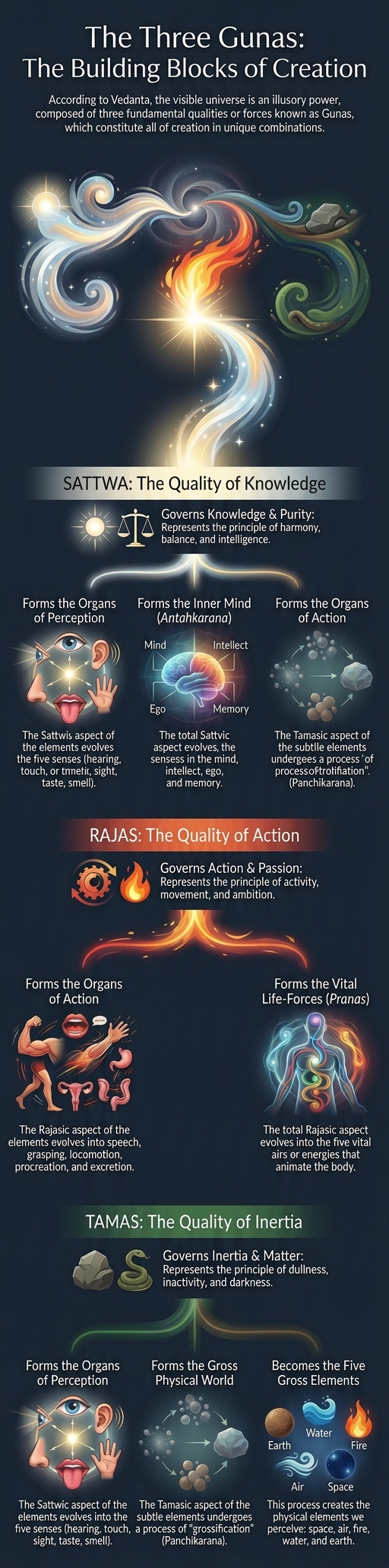
The philosopher Alfred North Whitehead proposed that the universe is made of “actual occasions of experience.” ⁵ In the Gita, this is reflected in the concept of prakriti (nature) being driven by the three gunas—dynamic qualities that “render” different experiences based on the observer’s state. If the observer is in a state of Sattva (purity/light), the world renders as order and clarity; if in Tamas (darkness/inertia), it renders as confusion.
This suggests that there is no “thing-in-itself” (the Kantian Ding an sich) outside of consciousness. Instead, we find a Participatory Ontology. As physicist John Wheeler famously stated with his “It from Bit” doctrine, every physical “it” derives its ultimate significance from “bits” of information—specifically, the information gained through measurement or observation. ⁶ Enoch’s journey through the “treasuries of the stars” and the “portals of the winds” describes a universe where every physical phenomenon is indexed and governed by a celestial “angel” or intelligent subroutine (Techno-Gnosis). Reality, in this philosophical view, is a scripted performance where the script and the stage are made of the same substance: awareness.
The Cosmological Dimension: Information Theory and the Akashic Records
From a cosmological standpoint, the Book of Enoch presents a “Nested Reality” model. The heavens are not just clouds and stars; they are hierarchical layers of complexity. Each heaven functions as a computational node, processing the laws of physics, ethics, and time for the levels below it. ⁷ This mirrors contemporary Integrated Information Theory (IIT), which suggests that consciousness is a function of the integration of information across a system. ⁸
In the Vishwarupa vision, Arjuna sees the entire cosmos—past, present, and future—existing simultaneously within Krishna’s body. This “collapsing of time” is a hallmark of a non-local, informational universe. It suggests that the cosmos is a block universe, a 4D structure where all events are already “written,” but are experienced linearly by the observer’s limited processing speed (Techno-Gnosis). ⁹
Furthermore, the concept of the Akashic Record (implicitly present in the Vedic tradition) and the “Heavenly Tablets” mentioned in Enoch suggest a cosmic database. Everything that has happened or will happen is stored as a persistent data state. The “Observer’s Awakening” is the moment the observer gains access to this database. In modern cosmology, the Holographic Principle suggests that the description of a volume of space can be thought of as encoded on a lower-dimensional boundary to the region—much like the information for a 3D image is stored on a 2D surface. ¹⁰ Enoch’s visions of the “ends of the earth” and the “gates of heaven” are essentially descriptions of the boundary conditions of our simulated reality.

The Psychological Dimension: Dissolving the User Interface
Psychologically, the transition from ordinary sight to “divine sight” involves the dissolution of the Default Mode Network (DMN)—the brain’s seat of egoic narrative. When Arjuna sees the universal form, he is terrified because his “User Interface” (UI) has crashed. ¹¹ Cognitive scientist Donald Hoffman argues that our perceptions have evolved not to show us the truth, but to hide it behind a set of “fitness icons.” We don’t see the complexity of the “cosmic code” (firmware of reality); we see “trees,” “cars,” and “enemies.” ¹²
Arjuna’s terror represents the psychological shock of seeing reality without the interface. He sees his relatives and teachers being consumed by the flames of Time (Kala), revealing that the stable world he thought he lived in is a fleeting projection. Enoch, too, falls on his face in terror when he witnesses the blinding brilliance of the Chariot of God. ¹³ This is what Rudolf Otto called the Mysterium Tremendum—the overwhelming awe of the “Wholly Other.”
However, the “Awakening” occurs when the fear is integrated. In transpersonal psychology, this is the shift from the Egoic to the Transegoic. ¹⁴ By recognizing that the “I” is not the body or the mind, but the observer of the code, the individual attains a state of “Unitive Consciousness.” The observer no longer feels like a “ghost in the machine” but as the awareness in which the machine is currently running. This psychological “firmware upgrade” allows for a life of radical presence and ethical clarity, as one realizes that harming another is essentially a “self-hit” in the unified field (Techno-Gnosis).

Contemporary Resonances: Quantum Mechanics and the Render
The bridge between these ancient visions and modern science is most visible in the Copenhagen Interpretation of quantum mechanics. The “Observer Effect” suggests that a subatomic particle remains in a state of probability (a wave function) until it is observed. ¹⁵ This “collapse of the wave function” is the ultimate act of reality-rendering.
If we apply this to the Gita, Krishna (the Ground of Being) is the infinite wave function of all possibilities. Arjuna (the localized observer) is the one whose interaction “collapses” that potential into a specific experience of a battlefield. Without the observer, there is no “battle,” only a sea of mathematical probabilities. This is echoed in Enoch’s descriptions of the “unseen things” which are made visible through divine decree.
Moreover, the Penrose-Hameroff “Orch-OR” theory suggests that consciousness arises from quantum computations in microtubules within brain neurons. ¹⁶ If this is true, then our brains are literally quantum biological “transceivers,” tuned to pick up the signals of the cosmic firmware. The “divine sight” described in the texts could be a poetic description of a state where these microtubules achieve a higher state of coherence, allowing the observer to perceive the quantum underlying of the world.
Practical Implications for Human Development
The integration of these insights has profound practical consequences. If reality is consciousness-mediated, then the quality of our consciousness determines the quality of our world. The term which is coined for this is Techno-Gnosis – Unlocking the Metaphysical Firmware of Reality.
• Contemplative Science: Meditation and mindfulness are not just relaxation techniques; they are “kernel-level” interventions to optimize the human hardware.
• Ethics of Interconnectedness: If the world is a holographic projection of a single awareness, then ethical behavior is simply the most efficient way to maintain system stability.
• Existential Resilience: Understanding the “block universe” and the immortality of the observer (as taught by Krishna) provides a powerful antidote to the fear of death, which is seen merely as the closing of one “application” and the opening of another. ¹⁷
Please check out my short YouTube video to get a snapshot of this paper: https://youtube.com/shorts/QSd9nVXlChk
Read similar thought provoking writings from my books -: https://livingspaark.com/book-store/#vol2
Endnote Listing (References)
1. Capra, F. (1975). The Tao of Physics: An Exploration of the Parallels Between Modern Physics and Eastern Mysticism. Shambhala Publications.
2. Nickelsburg, G. W. E. (2001). 1 Enoch 1: A Commentary on the Book of 1 Enoch. Fortress Press.
3. Prabhupada, A. C. B. S. (1972). Bhagavad-Gita As It Is. Bhaktivedanta Book Trust.
4. Radhakrishnan, S. (1948). The Bhagavadgītā. George Allen & Unwin.
5. Whitehead, A. N. (1929). Process and Reality. Macmillan.
6. Wheeler, J. A. (1990). Information, Physics, Quantum: The Search for Links. Proceedings of the 3rd International Symposium on Foundations of Quantum Mechanics.
7. Boccaccini, G. (2002). Roots of Rabbinic Judaism: An Intellectual History, from Ezekiel to Daniel. Eerdmans.
8. Tononi, G. (2012). Phi: A Voyage from the Brain to the Soul. Pantheon.
9. Stapp, H. P. (2007). Mindful Universe: Quantum Mechanics and the Participating Observer. Springer.
10. Susskind, L. (1995). “The World as a Hologram.” Journal of Mathematical Physics, 36(11).
11. Wilber, K. (1980). The Atman Project: A Transpersonal View of Human Development. Quest Books.
12. Hoffman, D. D. (2019). The Case Against Reality: Why Evolution Hid the Truth from Our Eyes. W. W. Norton & Company.
13. Charlesworth, J. H. (1983). The Old Testament Pseudepigrapha, Vol. 1. Doubleday.
14. Grof, S. (1985). Beyond the Brain: Birth, Death, and Transcendence in Psychotherapy. SUNY Press.
15. Heisenberg, W. (1958). Physics and Philosophy: The Revolution in Modern Science. Harper & Row.
16. Hameroff, S., & Penrose, R. (2014). “Consciousness in the universe: A review of the ‘Orch OR’ theory.” Physics of Life Reviews, 11(1).
17. Kastrup, B. (2019). The Idea of the World: A Multi-disciplinary Argument for the Mental Nature of Reality. Iff Books.
Target communities who may be benefit from reading this post
1. Quantum Physicists seeking conceptual frameworks for the observer effect.
2. Philosophers specializing in non-dualism and objective idealism.
3. Tech-Futurists interested in the intersection of AI, Simulation Theory, and spirituality.
4. Theological Scholars focusing on Vedic and Pseudepigraphal literature.
5. Transpersonal Psychologists exploring the phenomenology of mystical states

0 Comments